
Understanding Energy Charges, Demand Charges, and Capacity Tags — Why Cooling Loads Matter
For large industrial facilities, hospitals, commercial buildings, and data centers, utility bills are more complex than simply paying for electricity consumed.
Most large energy users pay for electricity in three primary ways:
-
Energy Charges
-
Demand Charges
-
Capacity Tags (or Peak Contribution Charges)
Each affects operating costs differently, but one major contributor often drives all three: cooling load.
Energy Charges: Total Electricity Consumed
Energy charges are the most familiar part of the utility bill and what’s obvious when it gets higher.
This is the total amount of electricity consumed over time, measured in kilowatt-hours (kWh).
The more electricity your facility uses, the higher your energy costs.
For facilities with significant cooling requirements, chillers often represent a major share of total electricity usage. This is especially true for:
-
Industrial manufacturing
-
Hospitals and medical campuses
-
Large commercial buildings
-
Data centers
The challenge is that cooling demand often rises when electricity costs are highest. A hospital that needs to run a 500-ton chiller plant around the clock can see cooling account for 30–40% of its total electric bill in summer months, often significantly more than lighting, medical equipment, and other mechanical systems.
Demand Charges: Your Highest Peak Matters
Demand charges are based on your facility’s highest electrical demand during a billing cycle, typically measured in kilowatts (kW).
Even a brief spike in usage can significantly impact your monthly bill.
For example, a manufacturing plant’s 800-ton air-cooled chiller plant might draw less than 720 kW most of the year. But on a 100°F July afternoon, with the processes heating up inside the building, the facility needs maximum cooling which causes the same chiller plant to spike to >1.3 MW of electrical use.
Many utilities don't average that spike away, they lock it in as the month's peak demand, and in markets with "ratchet" clauses, that single afternoon can set the demand charge for the next 11 months.
That’s why for many large facilities the cooling systems are one of the biggest drivers of these costly electrical peaks.
Capacity Tags: Paying for Grid Stress
Capacity tags, also called ICAP, PLC, or peak contribution charges depending on the region, are based on how much electricity your facility uses during periods of peak grid demand.
These charges help utilities recover the cost of maintaining sufficient grid capacity.
Grid peak events typically occur during the hottest days of the year, when cooling loads are highest.
In PJM territory, a facility's annual capacity obligation is set by its demand during just five "coincident peak" hours each summer. These peaks are usually only 10–15 minutes long, and not announced in advance. A facility that happens to be running chillers at full output during those narrow windows can have elevated capacity charges locked in for the entire following year, regardless of how efficiently it runs the rest of the time.
For energy-intensive facilities, this can represent a major financial burden.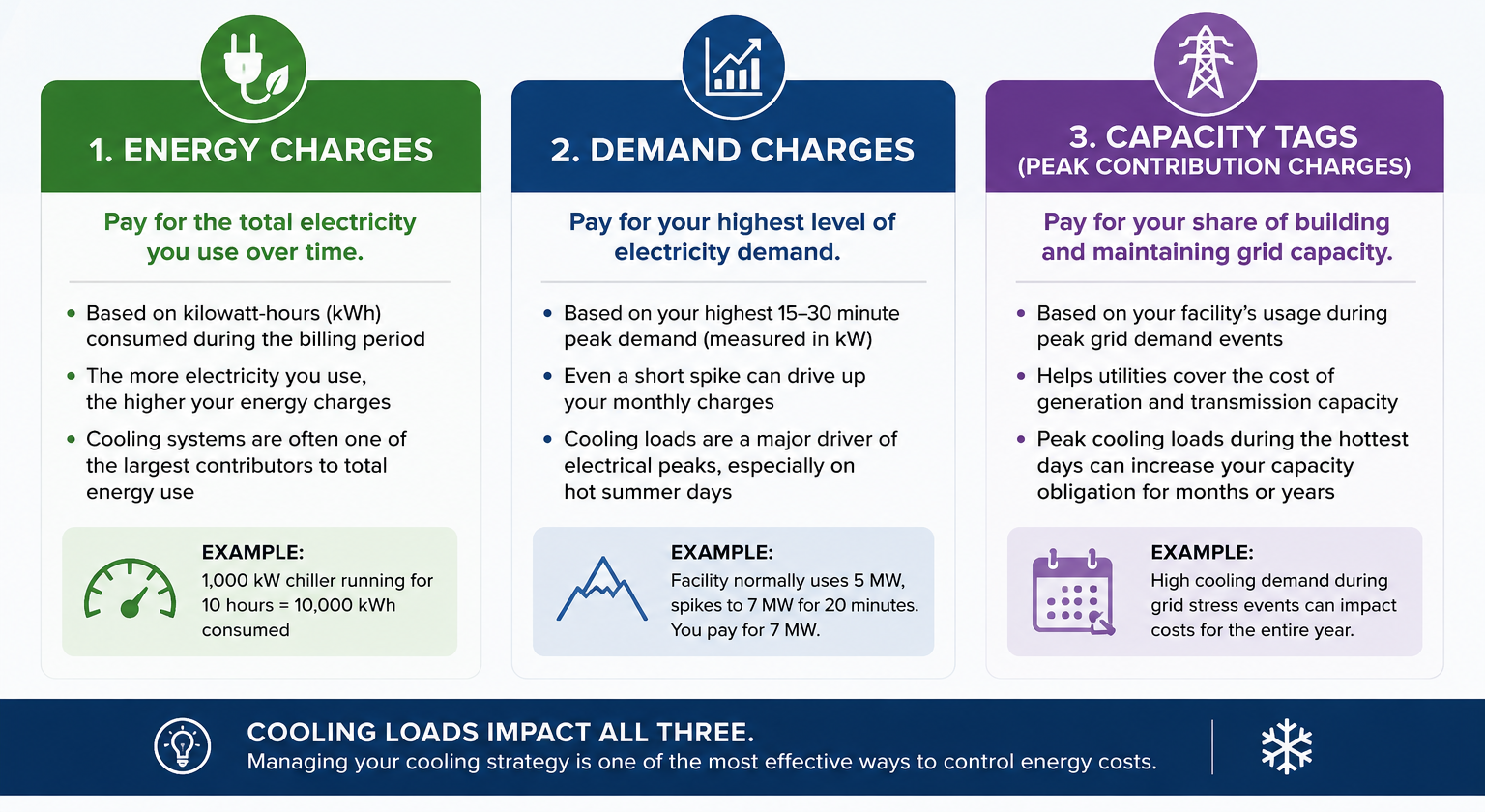
Cooling Is Becoming a Strategic Energy Decision
Cooling is no longer just an operational necessity, it is becoming a strategic lever for controlling energy costs.
For data centers especially, this challenge is growing rapidly.
A typical air-cooled data center with a PUE of 1.5 spends roughly a third of its total power draw on cooling. For a 100 MW facility, that's over 30 MW going to chillers and cooling infrastructure rather than GPUs. capacity that, freed up, could support several additional racks of compute.
The same principle applies across hospitals, industrial plants, and commercial campuses where electrical capacity is increasingly valuable.
The question is no longer just how to cool efficiently.
It’s how to use your available energy intelligently.
How Tecogen Hybrid Chillers Help
Tecogen Hybrid Chillers offer a smarter approach by combining electric and natural gas-powered cooling in a hybrid platform.
Instead of relying solely on grid electricity, facilities gain the ability to shift cooling loads between electricity and natural gas based on operating conditions.
This creates several advantages:
-
Reduce overall energy costs
-
Lower monthly demand charges
-
Reduce exposure to capacity tag costs
-
Improve resiliency during grid stress
-
Free up electrical capacity for higher-value operations
Apply that to the hospital example above: instead of letting the cooling cause an electrical demand spike over 1.3 MW, a hybrid chiller would shift part or all of the cooling load to natural gas engines, capping electrical draw or eliminating it all together. That one decision can avoid a demand-charge spike that would otherwise be locked in for nearly a year without reducing cooling capacity during the exact hours it's needed most.
Seamless Load Shedding During Peak Demand
One of the biggest advantages of hybrid chillers is the ability to seamlessly reduce electrical cooling load during peak utility periods.
When utilities are under maximum strain, and when energy, demand, and capacity costs are highest, facilities can shift cooling from electricity to natural gas.
This reduces grid dependence without sacrificing cooling performance. That creates value not only for the facility, but also for the grid.
As power constraints continue to challenge large energy users, hybrid cooling solutions are becoming a powerful tool for improving both economics and resiliency.
The future of cooling isn’t just efficient.
It’s flexible.